EasyCalc
EMI to Income Ratio (FOIR): How Much EMI Is Safe on Your Salary?
Banks check this ratio before approving any loan. You should check it before you even apply.
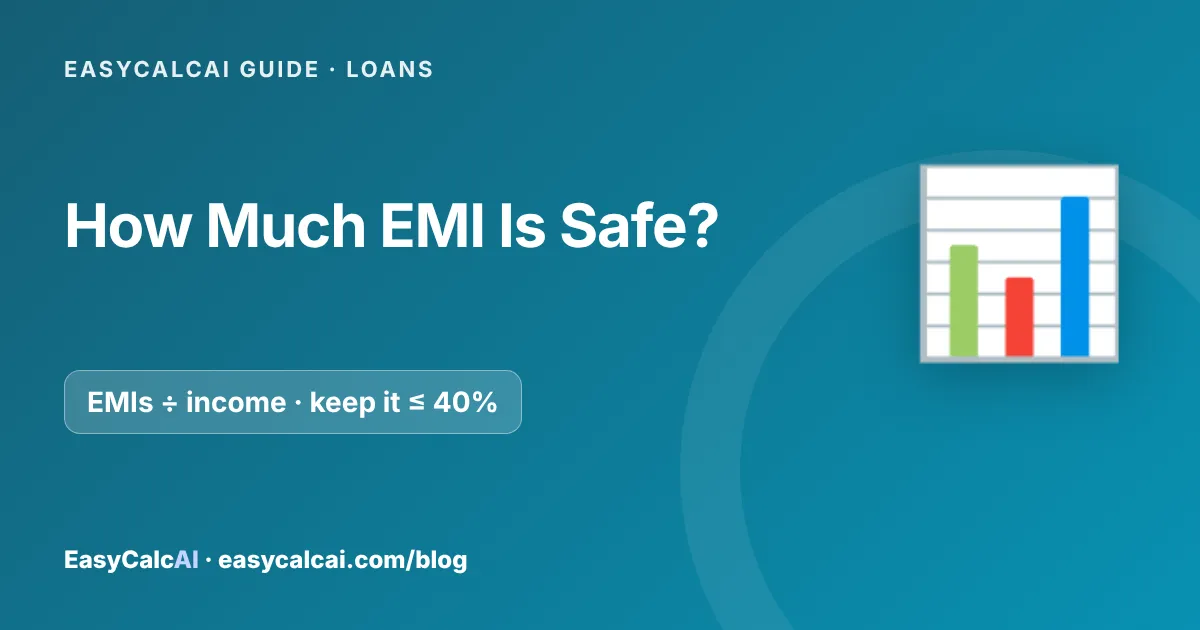
EMI-to-income ratio = total monthly EMIs ÷ monthly income × 100. ₹30,000 of EMIs on ₹90,000 take-home is 33%. Many lenders prefer total EMIs within about 40–50% of income (FOIR); for comfort, many planners suggest staying nearer 30–40%.
Enter your total monthly EMIs and income to check your ratio.
How to calculate it
Add every monthly EMI (home, car, personal, education loans, and credit card EMIs) and divide by your monthly income. Indian lenders call this FOIR, the fixed obligations to income ratio, and usually use net or gross monthly income depending on their policy. In the US the equivalent is the debt-to-income ratio.
Safe EMI by salary
| Monthly take-home | 30% (comfortable) | 40% | 50% (stretched) |
|---|---|---|---|
| ₹40,000 | ₹12,000 | ₹16,000 | ₹20,000 |
| ₹60,000 | ₹18,000 | ₹24,000 | ₹30,000 |
| ₹90,000 | ₹27,000 | ₹36,000 | ₹45,000 |
| ₹1,25,000 | ₹37,500 | ₹50,000 | ₹62,500 |
| ₹2,00,000 | ₹60,000 | ₹80,000 | ₹1,00,000 |
What lenders look for
Policies vary, but many banks allow total EMIs of around 40–50% of income, sometimes more for high earners. Your credit score, job stability and existing debts also matter. A lower ratio usually means better rates and faster approval.
How to lower your ratio
- Close small loans and credit card EMIs before applying for a big one.
- Choose a longer tenure (lower EMI, more interest; balance carefully).
- Add a co-applicant's income.
- Make a larger down payment.
- Use part of a bonus to prepay; see prepay vs invest.
Beyond the ratio
A 40% ratio leaves 60% for everything else: rent or maintenance, food, school fees, insurance and savings. Run your real budget through the 50/30/20 rule before you commit.
Real-life example
Rahul earns ₹1,00,000 take-home and pays ₹18,000 for a car loan. A bank allowing 50% FOIR would allow another ₹32,000 of EMIs. At 8.5% over 20 years, that EMI supports a home loan of about ₹36,87,387. Closing the car loan first would raise that by about ₹20,74,155.
Frequently asked questions
What is a good EMI-to-income ratio?
Under about 30–40% is comfortable; many lenders cap total EMIs at roughly 40–50% of income.
What is FOIR?
Fixed obligations to income ratio: your total monthly EMIs divided by monthly income.
How much EMI can I afford on ₹50,000 salary?
About ₹15,000–20,000 at 30–40% of income.
Do credit card dues count in FOIR?
EMIs on cards count, and many lenders also count a share of outstanding card balances.
Does closing a loan increase home loan eligibility?
Yes. Lower existing EMIs leave more room within the lender's FOIR limit.
Is FOIR calculated on gross or net salary?
It varies by lender; many use net monthly income.
Try your own numbers. It's free, instant and nothing you type is stored.
Sources
This guide is general information, not personal financial advice. Figures were checked on November 2026; rules and rates can change.
Related calculators
Related searches
- EMI to income ratio
- FOIR calculation
- how much EMI is safe on salary
- home loan eligibility based on salary
- debt to income ratio India
- how much loan can I get on 50000 salary
- FOIR for home loan
- EMI more than 50 percent of salary
- personal loan eligibility salary
- fixed obligation to income ratio
- home loan eligibility on 1 lakh salary
- FOIR SBI home loan
- how to increase loan eligibility
- net salary vs gross salary loan
- EMI calculator home loan
- car loan affect home loan