EasyCalc
The 50/30/20 Budget Rule: How It Works and How to Make It Fit
The simplest budget that actually works: three buckets, one rule, and no spreadsheets with 40 categories.
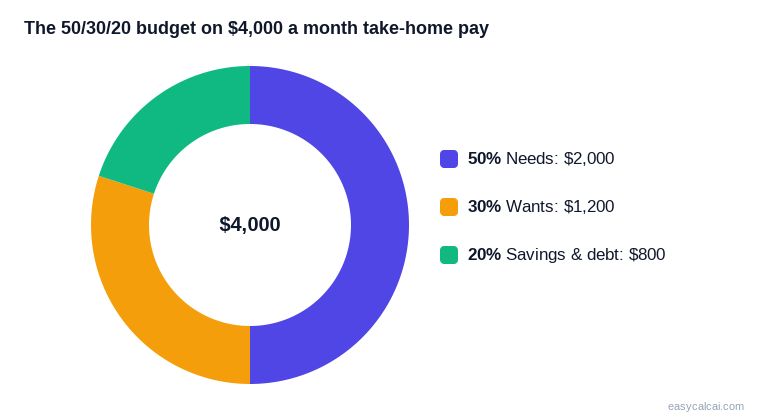
Split your after-tax income three ways: 50% for needs (housing, bills, groceries, minimum debt payments), 30% for wants and 20% for savings and extra debt payments. On $4,000 a month that's $2,000, $1,200 and $800.
Enter your monthly take-home pay to get your three budget amounts.
The rule in one minute
The 50/30/20 rule was popularised by US Senator Elizabeth Warren and her daughter Amelia Warren Tyagi in their 2005 book All Your Worth. It works on take-home pay: what reaches your bank account after tax, and after any pension or 401(k) contributions taken from your pay.
50/30/20 at different incomes
| Monthly take-home | Needs (50%) | Wants (30%) | Savings & debt (20%) |
|---|---|---|---|
| $2,500 | $1,250 | $750 | $500 |
| $3,000 | $1,500 | $900 | $600 |
| $4,000 | $2,000 | $1,200 | $800 |
| $5,000 | $2,500 | $1,500 | $1,000 |
| $6,000 | $3,000 | $1,800 | $1,200 |
| $8,000 | $4,000 | $2,400 | $1,600 |
Needs vs wants: where people go wrong
Needs are what you'd have to pay even in a tough month: rent or mortgage, utilities, basic groceries, insurance, transport to work, childcare and minimum debt payments. Wants are everything else: eating out, subscriptions, holidays, upgrades. A phone is a need; the newest phone on a premium plan is part need, part want. Anything above the minimum on a debt goes in the 20%.
When 50% isn't enough
In expensive cities, rent alone can be 40–50% of take-home pay. That's not a failure; adjust the split and keep the habit:
- 60/20/20 for high-cost areas: keep saving 20%, cut wants.
- 70/20/10 when money is tight: save something every month, even 10%.
- 50/20/30 once your needs are low: push savings to 30% or more and reach your goals years sooner.
What to do with the 20%
- A starter emergency fund (one month of expenses).
- Any employer pension or 401(k) match: it's free money.
- High-interest debt such as credit cards (see our minimum payment guide).
- A full emergency fund of 3–6 months.
- Long-term investing, and planned costs using a sinking fund.
Make it automatic
The easiest way to stick to the rule is to move the 20% to savings the day you're paid, pay bills from one account and spend the 30% from another. Check your progress every few months with the net worth calculator.
50/30/20 in other currencies
| Take-home | Needs 50% | Wants 30% | Savings 20% |
|---|---|---|---|
| ₹50,000 | ₹25,000 | ₹15,000 | ₹10,000 |
| ₹1,00,000 | ₹50,000 | ₹30,000 | ₹20,000 |
| £2,500 | £1,250 | £750 | £500 |
| C$5,000 | C$2,500 | C$1,500 | C$1,000 |
Irregular income?
Freelancers and gig workers can base the budget on their lowest typical month, put extra income straight into savings and taxes, and keep a bigger buffer of 3–6 months of needs.
Frequently asked questions
What is the 50/30/20 rule?
A budgeting rule that splits after-tax income into 50% needs, 30% wants and 20% savings and extra debt repayments.
Is the 50/30/20 rule before or after tax?
After tax. Use your take-home pay.
Do debt payments go in needs or savings?
Minimum payments are needs. Anything you pay above the minimum counts toward the 20%.
What if my rent is more than 50% of my income?
Use a 60/20/20 or 70/20/10 split for now, keep saving something every month, and review your housing costs when your lease or deal ends.
Does the 50/30/20 rule work in India?
Yes, using take-home pay; many families adjust to 60/20/20 because of rent or EMIs.
What if I have irregular income?
Budget from your lowest normal month and save surplus income in good months.
Try your own numbers. It's free, instant and nothing you type is stored.
Sources
- Consumer Financial Protection Bureau – Budgeting: how to create a budget and stick with it
- Consumer.gov (FTC) – Making a budget
This guide is general information, not personal financial advice. Figures were checked on November 2026; rules and rates can change.
Related calculators
Related searches
- 50/30/20 rule
- 50 30 20 budget calculator
- how to budget my salary
- what counts as needs vs wants
- budget for $4000 a month
- 70/20/10 budget
- simple budget plan
- how much should I save each month
- 50 30 20 rule India
- budget for 50000 salary
- how to budget irregular income
- zero based budget vs 50 30 20
- budget percentages by category
- how much should I spend on rent